
4 Notable Health Tech Funding Announcements in October
Health tech companies made several major funding announcements in October. Here is a list of some of the biggest funding rounds.
Health tech companies made several major funding announcements in October. Here is a list of some of the biggest funding rounds.

Mount Sinai Health System is betting on Microsoft’s Dragon Copilot as its ambient scribing tool of choice, a decision that followed competitive tests against rival vendors Abridge and Suki. Lisa Stump, Mount Sinai’s chief digital information officer, noted that the health system has been transparent with Microsoft that their partnership may change given Epic’s launch of a built-in AI charting tool earlier this month.


What if health plans could identify member decline before an avoidable hospitalization occurs? Real-time clinical visibility into long-stay SNF members uncovers risk earlier and drives better outcomes.
January has seen a slew of executive hires, promotions and layoffs across the healthcare industry. For instance, Aidoc, Suki and Particle Health named new executives. There were also layoffs at organizations including Takeda, Trinity Health and Horizon BCBS New Jersey.

The CEOs of Nabla, Suki, Ambience Healthcare and Abridge separately spoke with MedCity News about why their products have staying power despite imminent competition from Epic.
July has seen a slew of executive hires, exits and layoffs across the healthcare sector. For example, Aledade and Teladoc Health welcomed new executives, and DexCom and Community Health Systems announced that their CEOs are departing. There were also layoffs at organizations including Best Buy Health, the VA and Sarepta Therapeutics.

Healthcare organizations are starting to implement AI agents — autonomous, task-specific systems designed to perform functions with little or no human intervention. While initial adoption is focused mainly on non-clinical areas like scheduling and prior authorizations, experts predict that AI agents could eventually play a role in clinical decision-making, provided they meet rigorous safety and reliability standards.


Healthcare payments are no longer about transactions. It’s about controlling the revenue cycle. And increasingly, that control is not sitting with ISOs.

In collaboration with Google Cloud, Suki added two capabilities to its AI assistant: patient summaries and Q&A functionality. These new features might help Suki differentiate itself from other companies selling AI-powered tools to help with documentation and coding, such as Abridge, DeepScribe and Microsoft.

Here are nine notable announcements shared at the HLTH conference held this week in Las Vegas.

Suki's $70 million Series D financing round was led by Hedosophia and included participation from Venrock, March Capital, Flare Capital, Breyer Capital and inHealth Ventures.

Meditech is integrating Suki’s AI assistant into more than a dozen rural health systems, including St. Mary's Healthcare in New York and Decatur County Memorial Hospital in Indiana.

Healthcare decision-makers, especially at pharmaceutical companies, must prioritize patient input. Data collected from social media listening is a significant step in the right direction.

Health systems across the country are launching enterprise-wide deployments of AI-powered clinical documentation tools. Hospital leaders agree that this technology reduces physician burnout, as well as allows physicians to have more meaningful and productive interactions with patients.

Suki recently announced one of its biggest partnerships to date: it is integrating its voice assistant into Epic’s EHR. The startup's assistant can be thought of as like Apple’s Siri or Amazon’s Alexa — but for doctors.

Voice-enabled technology powered by AI reduces documentation time by several hours per week, but physicians won’t adopt a solution unless it’s affordable and intuitive.
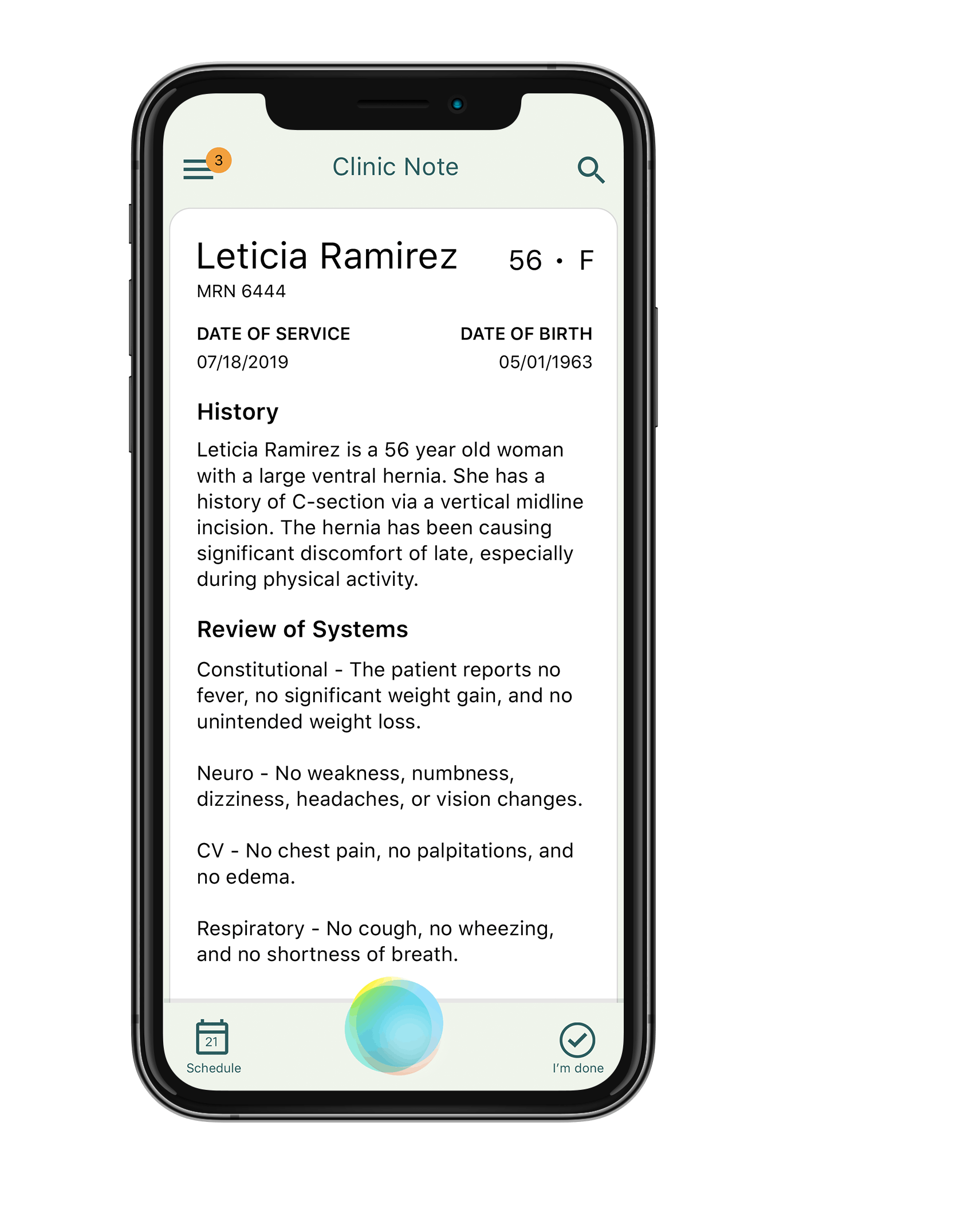
The voice solution Suki Assistant uses machine learning and natural language processing to accurately understand and document information and respond to physician commands, according to the company.

The company is working on a voice assistant to lighten clinicians’ documentation burdens by automating some of that work. It faces competition from large companies like Nuance, which was acquired by Microsoft earlier this year.